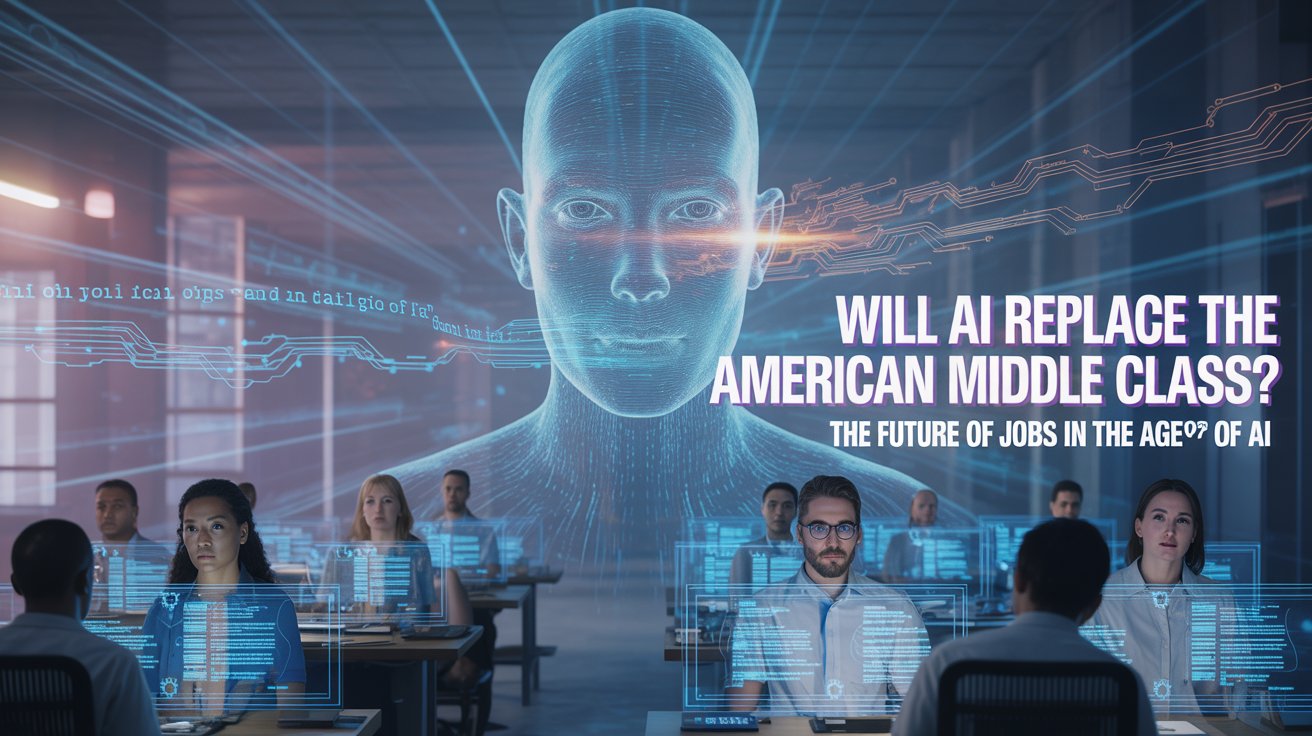
By [Rankspowertech]
The rise of Generative AI has moved the question of job automation from a sci-fi fear to a daily reality. While the initial anxiety focused on factory floors and service roles, the real tectonic shift is occurring quietly inside cubicles and corporate offices. The American middle class—the backbone of the U.S. economy, built on predictable, process-driven professional roles—is now squarely in AI’s crosshairs.
The question is no longer if AI will change the middle class, but how fast, how deep, and what kind of new economic structure will emerge from the disruption.
The New Automation: AI Targets Cognitive, Not Just Manual, Labor
For decades, economists spoke of automation impacting manual and blue-collar jobs. Today, the roles most exposed to AI are white-collar, educated positions—the very engine of the middle class.
A 2025 analysis by Goldman Sachs found that two-thirds of jobs in the U.S. and Europe are exposed to some degree of AI automation. The key difference in this wave of automation is that AI doesn’t replace the job, it replaces the task.
💼 The Middle-Tier Professions Most at Risk:
AI excels at routine cognitive tasks that form the foundation of many mid-level, middle-class careers. According to data from Goldman Sachs and other market analyses, the following professions face the highest risk of disruption:
Profession High-Risk Tasks Ripe for Automation
Accountants & Auditors Routine data entry, reconciling ledger accounts, generating initial compliance reports.
Legal & Administrative Assistants Drafting basic legal documents, summarizing court records, scheduling, and file management.
Customer Service Representatives Answering FAQs, basic troubleshooting, first-tier support triage.
Computer Programmers Generating basic code, debugging existing functions, and translating code across languages.
Financial Analysts Processing large datasets, running standard risk models, and generating initial earnings reports.
It is important to note that many of these roles require a four-year degree, placing them squarely in the traditional definition of the American middle class. AI is proving that education is no longer a shield against automation.
The Great Bifurcation: The Splitting of the American Worker
The primary threat of AI is not mass unemployment, but rather an acceleration of economic inequality—a process Ray Dalio famously described as the economy splitting into two worlds.
1. The Augmenters (The Top 20%)
This group, which includes highly specialized knowledge workers, executives, and AI-literate professionals, will see their productivity surge. For them, AI is a co-pilot, allowing one worker to do the job of three or four.
The Benefit: Professionals who master AI tools will experience massive productivity gains, leading to higher wages and increased demand for their judgment, empathy, and strategic thinking—the skills AI cannot replicate.
The Risk: Even this group must constantly re-skill to keep pace, or their own specialized roles will fragment into smaller, automatable tasks.
2. The Task Automata (The Bottom 80%)
This group—primarily composed of mid-level workers who perform repetitive, procedural tasks—will face intense wage pressure and job displacement.
The Impact: As a single accountant uses AI to handle the workload of three, the market only needs one accountant. The displaced workers are forced into a tight labor market or into low-wage service jobs that require unpredictable, in-person tasks (caregiving, highly customized service).
The Outcome: This dynamic risks hollowing out the middle of the income distribution, pushing middle-class workers toward lower-paying tiers and accelerating the existing wealth gap.
Beyond the Panic: A Call for AI Fluency, Not just Literacy
The most critical factor determining an individual’s success in the AI economy will be their AI Fluency. Simply being “digitally literate” is no longer enough. The American education and corporate training systems must pivot to focus on three core areas:
1. Prompt Engineering and AI Orchestration
The ability to communicate effectively with an AI (prompting) and integrate multiple AI tools into a seamless workflow (orchestration) will become the universal “soft skill” of the future.
2. Uniquely Human Skills
The premium on skills that require genuine human interaction, complex ethical judgment, and deep emotional intelligence will soar. These include:
Ethical Oversight and Governance
Creative Problem-Solving (outside a dataset)
Mentorship and Team Building
Empathy-Driven Sales and Service
3. The Culture of Continuous Learning
As AI evolves every six to twelve months, a job title will no longer be a lifelong identity. The ability to “learn, unlearn, and relearn” will be the most valuable asset in the modern professional’s toolkit, replacing the stability that once defined the American middle class.
The Verdict
Will AI replace the American middle class? No, not entirely. But it will radically redefine it.
The middle class of the future will not be characterized by the stability of a job title, but by the flexibility of its skill set. The economic reward will flow to those who use the algorithm, not those who are controlled by it. For the U.S. economy, the challenge is clear: invest massive resources now into re-skilling the current workforce to become AI Augmenters, or risk cementing a two-tiered economy where the promise of middle-class stability disappears
for generations to come.

In 2025, sustainable fashion is no longer just a buzzword — it’s a lifestyle choice. Modern shoppers want style, comfort, and responsibility in one look. Whether you’re searching for a women’s sustainable linen summer dress online or a men’s slim fit black leather bomber jacket on sale, the key is to balance trend with timelessness.
4. How to Accessorize Sustainably
Adult içerik kategorisi.
Finans manipülasyonu.
whoah this blog is great i love reading your articles. Stay up the good work! You already know, lots of persons are searching around for this info, you could aid them greatly.